
Complete and accurate records matter for a number of reasons, some of which many people will not realise to what extend and how.
Here is a list of factors that affect people with regards to their rights and what complete (or lack of complete records) means, especially to adoptees.
The original birth registrations of adoptees may not be certified, but they are still active legal documents, used for a number of things around the world.
1. The Right to Claim the Nationality of Another country
A number of countries now recognise the original birth registration of adoptees as being a valid legal document in order to claim nationality and citizenship, even though they are not certified. They are seen as legal supporting documents to make the claims with.
For example, the UK puts the father’s name onto the original birth registration of adoptees for this reason, so that the adoptee can claim the nationality of the father if it is different from either the mother or the adoptive parents. The adoptee may be seen as British but if the father is East European, having the father’s name on the original birth registration means the adoptee can also claim the East European Nationality for the purposes of getting citizenship there and even going to live in Eastern Europe.
From the UK – “The grant of declarations of parentage to legally recognise the applicant women’s birth fathers and rectify their original birth certificates to add the name of their biological or birth father despite their adoption as babies resolved fundamental aspects of their identity. In doing so it: … opened the door to obtaining dual citizenship” https://louisaghevaertassociates.co.uk/declaration-of-parentage-confirming-family-ancestry-and-biological-parentage-following-adoption/
2. The Ability of Fathers to Obtain Information in the same way as Mothers do
If the father’s name is missing from the original birth registration, he is not allowed identifying information on his adult son or daughter in the same way that the mother would be allowed (in Ontario, although similar rules apply across Canada). Only fathers named on the original birth registration of the adoptee are allowed this. In Ontario, this means that over 90 percent of fathers of adoptees are not allowed this right.
From the Birth Parent’s Guide for Completing and Submitting an Application for Post Adoption Birth Information under the Vital Statistics Act (Ontario).
Page 2 – Section B – Service Requested.
“Identification of the Applicant: Please use this section to confirm you are a mother or father/other parent (see below) named on the original birth registration by checking only one box in this section. If you check more than one box, your application will not be accepted and will be returned for correction.
Other parent: A child’s birth can be registered with either one or two parents named on the birth registration. “Other parent” was a category of parent added to birth registration forms in 2007. It means a person who consents to be acknowledged by the mother as the parent, if the biological father is unknown and the child was born of assisted conception with an anonymous sperm donor.”
3. Indigenous Status/Registration Rights
In Canada, the missing father’s name can make a difference as to whether an Indigenous person can claim Indigenous Status rights.
Unknown or unstated parentage (from Government of Canada web site)
Parentage is the identity and origins of one’s parents, grandparents or other ancestors.
Registration under the Indian Act, is based on parentage and the degree of descent from ancestors who are registered or entitled to be registered. When parentage is asserted in an application for registration, there may be situations where the identity of a parent, grandparent or other ancestor is unknown or unstated. Those types of situations could affect a person’s ability to prove entitlement to registration. https://www.sac-isc.gc.ca/eng/1710868412176/1710868541374
Indigenous adoptees can choose to be registered under the Indian Act (Canada) through their original (birth) parents or their adoptive parents.
If the Indigenous adoptee’s adoptive parents are not Indigenous (First Nations), then it makes it even more important to get as much information as they can about their original (birth) family.
The First Nations Assembly has a fact sheet on this. https://www.afn.ca/wp-content/uploads/2020/01/17-19-02-06-AFN-Fact-Sheet-Adoption-and-Indian-Registration-final-revised.pdf
4. Conflict Between Federal Advice and Ontario law on correcting records
There is conflict between the Federal government’s advice given to Indigenous adoptees, telling them to add the father’s name to the adoptee’s original birth registration for the purpose of registering status, and Ontario law that forbids them from doing so!
These two things are at odds with each other. Ontario needs to be brought into line with Federal policies and advice. The Federal government should use the Power of Federal Paramountcy to over-ride Ontario law to do so, if Ontario refuses to repeal Section 28(6) of the Vital Statistics Act.
From the Canadian Government web site;
“Are you entitled to be registered through a parent not listed on your proof of birth document
A proof of birth document listing the names of the parents is the main document needed to support entitlement to registration.
If one of the biological parents isn’t listed on the proof of birth document but is registered or entitled to be registered, you can submit:
- an original amended proof of birth document listing the unstated parent’s name“
How can the Indigenous adoptee give the Federal government an amended original birth registration that has listed the unstated parent’s name when Ontario law will not allow this?https://www.sac-isc.gc.ca/eng/1710868681038/1710868708332
5. Genealogy – Family History
Genealogy matters to a lot of people. Adoptees can feel left out of “Genealogy Day” events that encourage people to look up their family history.
6. Family reunification
Without all of the information on the birth registration, it can be difficult to reunite with the original family, especially if the parents are dead.
7. Medical Information
Without having both parents on the birth registration, half of the medical information can be missing.
8. Having the same Rights as Non-adopted to have Complete Records
By not letting adoptees correct their birth registrations as the non-adopted can, adoptees are being treated as 2nd class citizens, and not equal before the law. This is discrimination on birth status grounds and can affect the mental health of adoptees being seen as “lesser” human beings with less rights.
9. Mental Well-being
Not being allowed the same rights of the non-adopted can affect the mental well-being of an adoptee. It can lower self-esteem and cause frustration at not being able to correct their personal records.
10. Incorrect Records can cause Statelessness
Adoptees whose records are not in order can find themselves stateless.
They can also find that they are unable to get passports, access to education, etc.
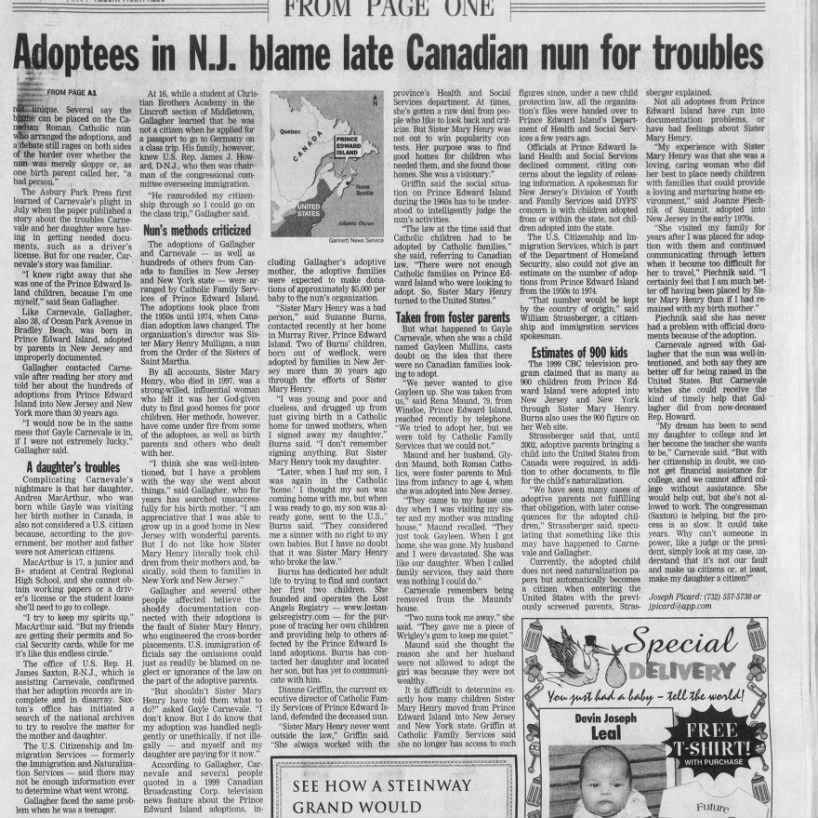
Sister Mary Henry Mulligan trafficked babies from Prince Edward Island to the US (mainly the New York area). The documentation was dodgy or lacking in many cases. Adoptees have found themselves to be made stateless in the US because of it. They have also been unable to access education, get a passport, etc. https://www.newspapers.com/article/asbury-park-press-prince-edward-island-a/17273295/
Below are links to the pages on our web site.
 LOOKING IN ONTARIO